Where? Ground floor, room 403 of the Denon wing in the Louvre
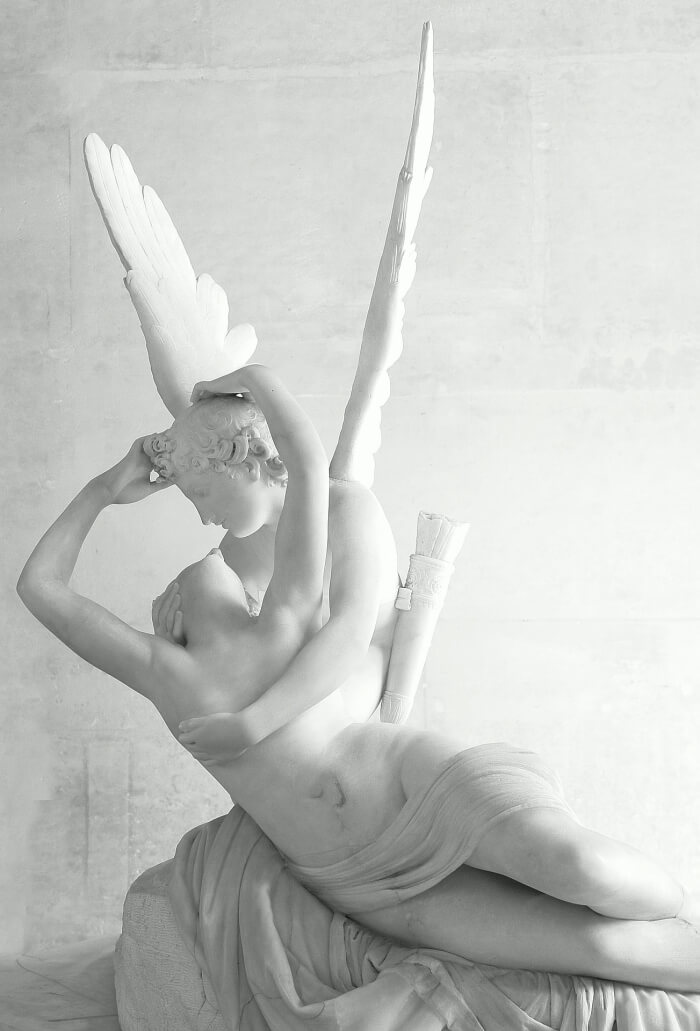
When? 1787-1793 Commissioned by? Colonel John Campbell What do you see? The moment at which the lifeless body of Psyche is just brought back to life by Cupid. The figures of Cupid and Psyche (except the wings) are positioned in a pyramid shape, which creates a stable form for the sculpture. Cupid sits on one knee on top of a rock and holds Psyche by her head and breast. He has large wings pointing straight up into the air and wears his arrows in a quiver on his back. Psyche reaches up to Cupid and has her hands on his head. She lets her head hang back and they are about to kiss. Her long hair reaches all the way to the ground. She has a cloth wrapped around her lower body. Behind them lays the flask with the ointment that Psyche had collected from the underworld. Directly to the right of the flask is Cupid's arrow, which he used to wake up Psyche. This story symbolizes the big efforts and challenges a human must undergo to achieve happiness and immortality. Look also at the precision with which Canova created the smooth bodies of Cupid and Psyche. This smoothness contrasts nicely with the wrinkly texture of the sheet wrapped around Psyche and the rougher texture of the rock on which they sit. Near the right foot of Psyche is a handle, which was originally included to turn the sculpture around as it was worth seeing this sculpture from all possible angles. 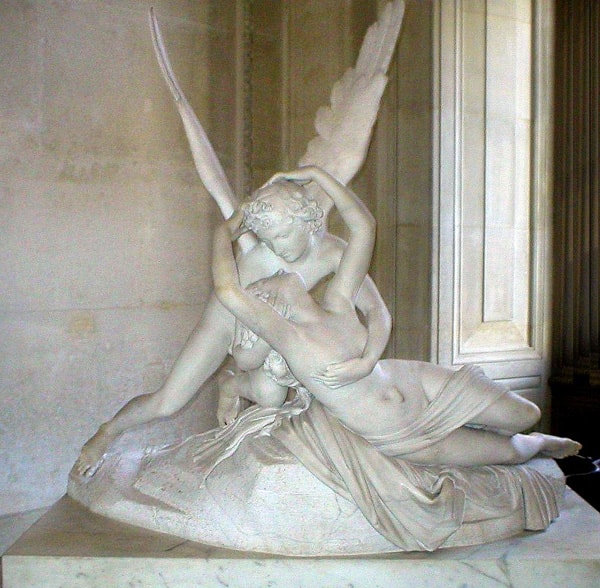
Pysche Revived by Cupid's Kiss from another angle
Backstory: This sculpture is based on a story the Roman writer Apuleius wrote in his book Metamorphoses, chapters four, five, and six (you can download the book here for free). In short, Psyche was considered the most beautiful woman alive, and Cupid fell in love with her. The painting Cupid and Psyche in the Cleveland Museum of Art by Jacques-Louis David shows the couple after they made love.
The goddess Venus was jealous of Psyche's beauty and sent her on a very dangerous journey to the underworld to collect a flask with Proserpina’s beauty ointment. Psyche succeeds with the help of Cupid. Venus instructed Psyche not to open the flask, but after she completes the journey, she could not resist and opened it to take some of the content. But instead of becoming more beautiful, the ointment makes her fall in a very deep sleep as Proserpina had filled the flask with sleep of the innermost darkness. Cupid forgives Psyche and revives her. He asks for the help of Zeus who makes Psyche immortal. Cupid and Psyche marry and stay together forever. Multiple Versions: Antonio Canova created another version of this statue for the Russian art collector Prince Yusupov. This version was made in 1796 and is now in the Hermitage Museum in Saint Petersburg. It differs somewhat from the current version as Yusupov asked for some changes. For example, he wanted the cloth on Psyche to cover her legs completely. The favorite student of Canova, Adamo Tadolino, inherited the plaster model for this sculpture, which is now at the Metropolitan Museum of Art. He used this model to create at least five known marble replicas of this sculpture with small modifications. He added, for example, small butterfly wings to the back of Psyche and created smaller wings for Cupid. 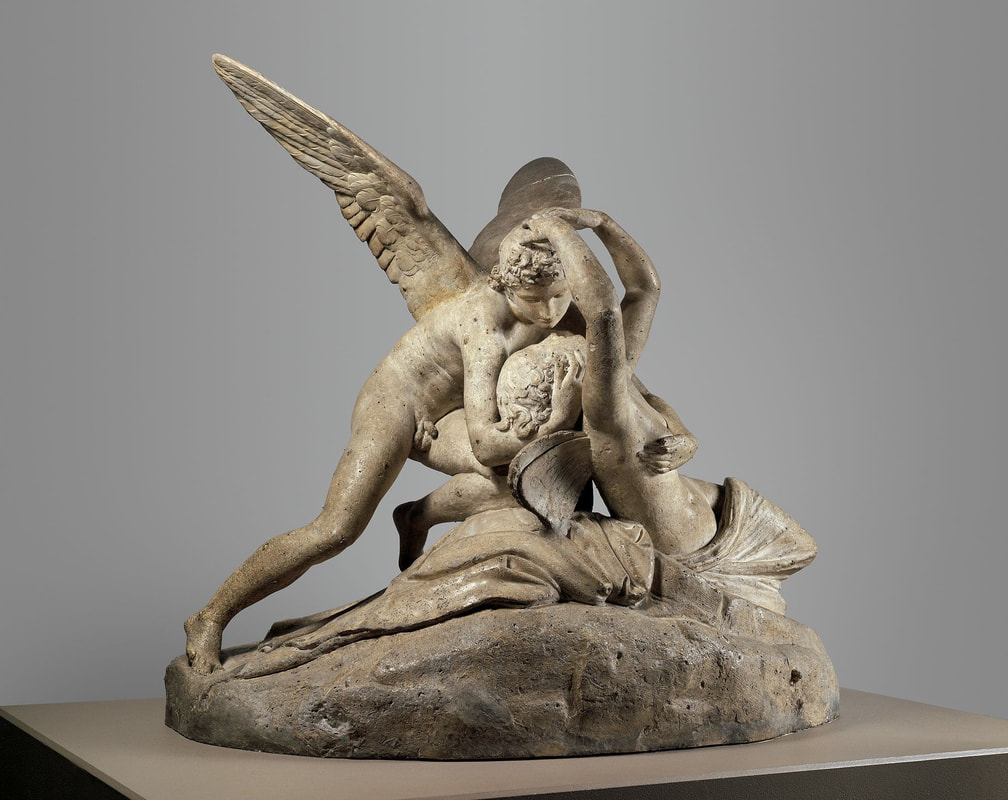
Plaster Model for second version of Pysche Revived by Cupid's Kiss by Canova
Who is Psyche? One of the three daughters of an unknown king and queen. She was very beautiful, and people treated her like a goddess. Venus was jealous of her beauty and the way she was treated. She asked her son Cupid to use his arrows to make her marry the ugliest of all human beings. However, when Cupid saw Psyche, he fell in love with her.
Psyche's father went to an oracle to ask why her daughter had not married yet. The oracle said that Psyche should be left behind there immediately as otherwise terrible disasters would happen. Next, the god Zephyr blew her away and put her in a palace by herself. There, every night she made love to a person that she was not allowed to see. This person was Cupid. When she discovered this, Cupid fled. To get him back, Psyche followed the instructions of Venus to gather a beauty ointment from the underworld as described above. Who is Canova? Antonio Canova (1757-1822) was born in Possagno, a small town in the Northeast of Italy. He studied arts in Venice and then moved to Rome at age 23 to start his own workshop. He completed various commissions for the Pope while in Rome. In 1802, he moved to Paris where he created several sculptures for Napoleon. He was inspired by the ancient Greek and Roman sculptures. He revived this classical style and Canova is considered to be the prime Neoclassical sculptor. His sculptures are praised because of their perfect form and finish. The careful finish of the human bodies makes his statues look like real flesh and makes them come alive. An example of another great sculpture of Canova is Perseus with the Head of Medusa in the Vatican Museums. A replica of this statue can be found in the Metropolitan Museum of Art. 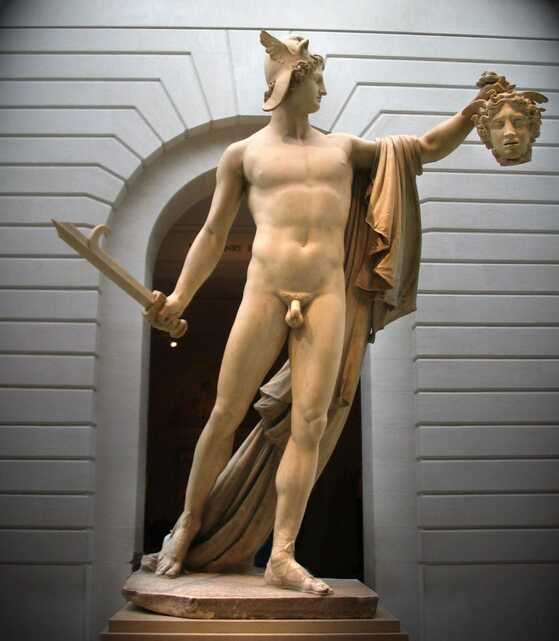
Perseus with the Head of Medusa by Canova
Fun fact: Canova conducted extensive research to create this sculpture. The position of Cupid is copied exactly from a painting he saw in Herculaneum near Naples. After many sketches, he then created numerous clay figures of the sculpture. Unlike many other sculptors who created small-sized clay models for a sculpture, Canova created the clay models at their real size. This helped him to accurately sculpt his work in marble.
Note that the flask and the wings of Cupid are sculpted separately and are inserted into the rest of the sculpture. For example, you can still see some marks on where the wings are attached to Cupid’s back. Finally, Canova had special curved chisel tools designed for him, which he used to carve out the sculpture’s most inaccessible places. This attention to detail makes him one of the most admired sculptors in history.
0 Comments
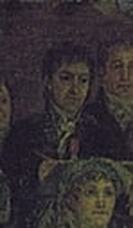 Jacques-Louis David in the background Jacques-Louis David in the background
Where? The original is on the first floor, Room 702 of the Denon wing in the Louvre. A copy by David is in The Coronation Room of the Palace of Versailles.
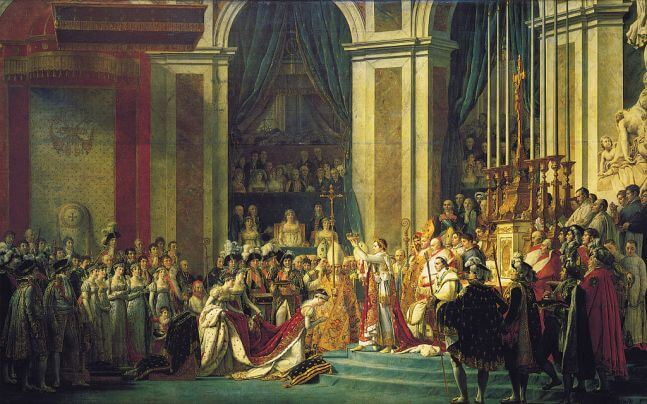
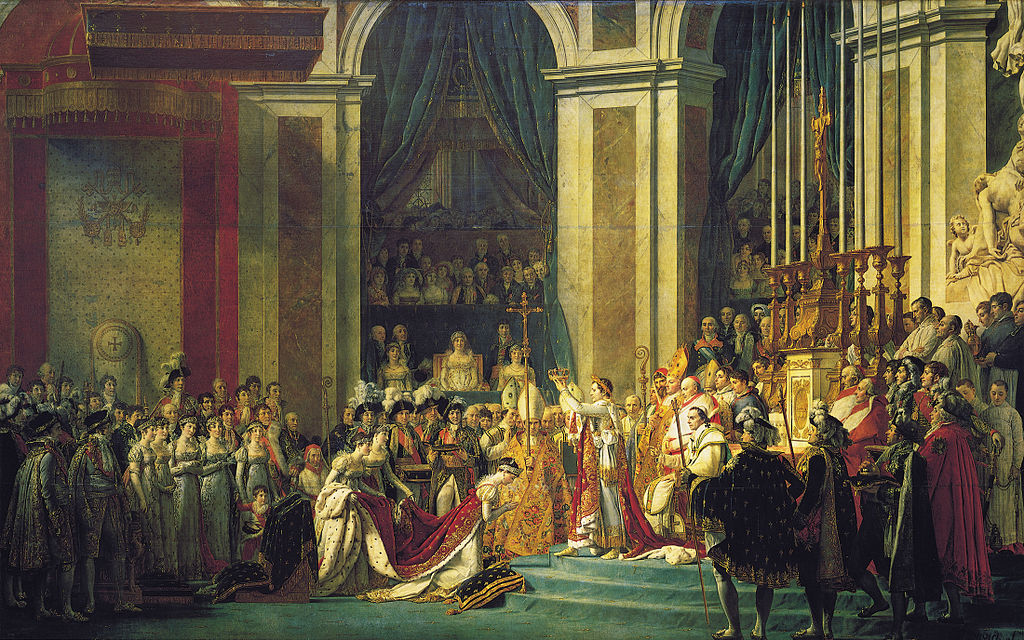
When? 1805-1807 Commissioned by? Napoleon Bonaparte Also known as? This painting is officially entitled The Coronation of the Emperor Napoleon I and the Crowning of the Empress Joséphine in Notre-Dame Cathedral on December 2, 1804. What do you see? A large number of almost life-size figures are present in the Notre-Dame Cathedral for the coronation of Napoleon Bonaparte. This painting (979cm x 621cm) is one of the largest works in the Louvre. Napoleon is the person in the middle holding the crown, and the painting shows the moment that Napoleon is about to place the crown on the head of his wife Joséphine who is kneeling on a pillow. Napoleon wears his coronation robe, which is similar to the robes worn by Roman emperors. The person sitting to the right of Napoleon is Pope Pius VII. He blesses the coronation but is participating involuntarily under the pressure of Napoleon. The woman in the white dress sitting on a chair in the center of the painting is the mother of Napoleon. In the left foreground, you can see the two identically dressed (wearing black hats) brothers of Napoleon, Joseph (on the left) and Louis (on the right). To the right of Napoleon’s brothers are his three sisters (also identically dressed). From left to right, they are Caroline, Pauline, and Elisa. To the right of Napoleon's sisters, and again similarly dressed, are Hortense (the daughter of Joséphine) and Julie Clary (the wife of Joseph Bonaparte). In the background, Jacques-Louis David also painted himself as he was present at this event. Finally, look at the expressions of all the 204 faces in the painting. They all look quite serious, signifying the importance of this event. Backstory: This painting captures an important event in history, and Jacques-Louis David was in the audience that day. On December 2, 1804, the 35-year-old Napoleon Bonaparte crowned himself during a five-hour ceremony as the first Emperor of France. And he crowned his 41-year-old wife Joséphine as the first Empress. Before the French Revolution of 1789, France was a monarchy, but the revolution turned France into a republic. This painting shows the moment that Napoleon turned France back into a monarchy. He brought in Pope Pius VII from Rome to bless him at the event. The painting is a fairly accurate representation of history, but not everything in the painting is true. Several details are changed to favor Napoleon. For example, the mother of Napoleon, Letizia Bonaparte, was in Rome during the coronation, but she still received a prominent place in this painting. Napoleon's brother Joseph on the left was also not present at the event. When David finished the painting and Napoleon saw it for the first time, he said: “It is not a painting. There are people walking in this picture. Life is everywhere. David, I salute you. You have made me a French knight.” Two versions: Jacques Louis David finished the original version of this painting in 1807. It was originally on display in the Palace of Versailles but was moved to the Louvre in 1889. Between 1808 and 1822, David painted a second version of this painting for some American businessmen. The Palace of Versailles acquired it in 1947. David painted this copy based on the preparatory drawing he had for the original, and the two versions differ slightly from each other, though the differences are minor. 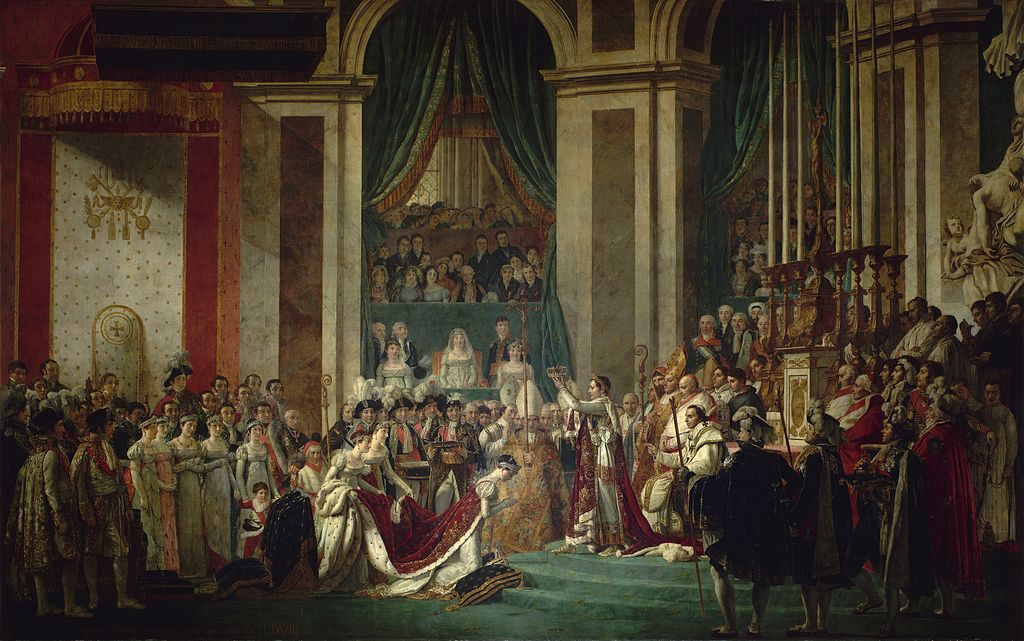
Coronation of Napoleon by David in Palace of Versailles
Who is Napoleon? Napoleon Bonaparte (1769-1821) was one of the leaders of the French Revolution in 1789. He was a successful military leader, and he became a general in the French army at age 24. He was the leader of a coup in 1799 and eventually crowned himself as the emperor of France in 1804.
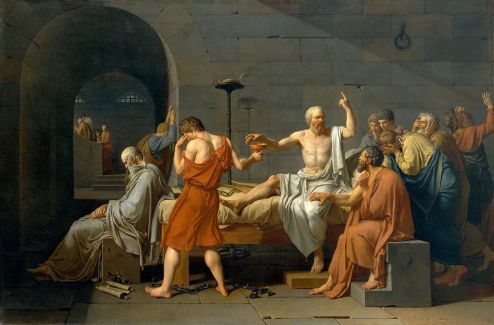
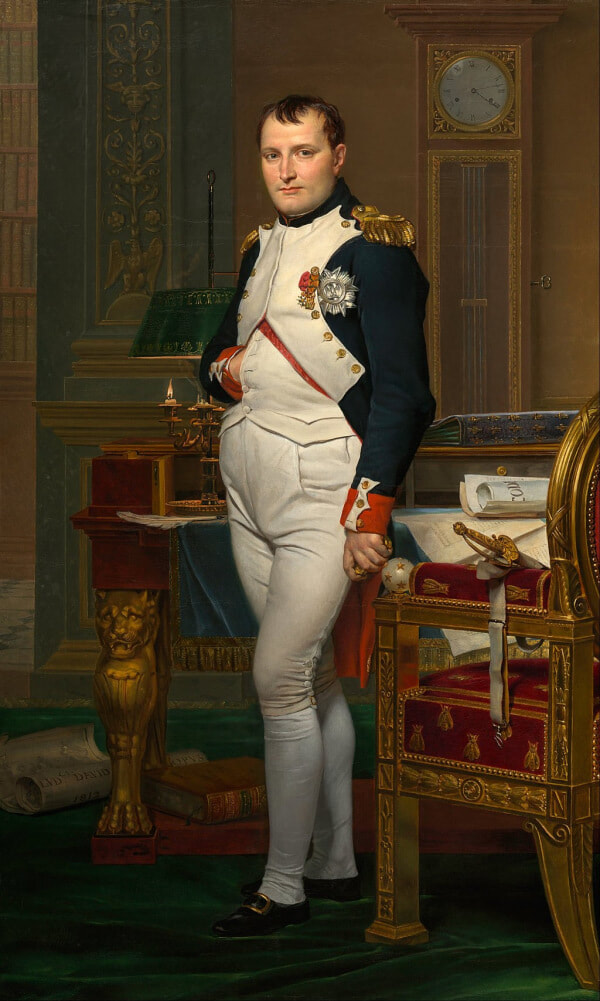
Napoleon was married to Joséphine who is crowned in this painting. He divorced her in 1809 because she could not get children (even though she got two children from her previous husband). He later married Marie Louise, the daughter of the Emperor of Habsburg. He died in 1821 while in exile on the remote island Saint Helena in the middle of the Atlantic Ocean. Who is Jacques-Louis David? Jacques-Louis David (1748-1825) was considered the best painter of his era. From a young age, he received a great education in arts. In 1774 he won the Prix de Rome, a prestigious art scholarship that allowed him to work for five years at the French Academy in Rome. David abandoned the dominant Rococo style and developed a Neoclassical approach. He was specifically inspired by the works of Raphael and painted many historical scenes inspired by ancient Greece and Rome. For example, in 1787 he painted The Death of Socrates, which is in the Metropolitan Museum of Art in New York. During the time of the French revolution, David was involved in politics and devoted himself to Napoleon who knighted him in 1803. In 1812, he painted The Emperor Napoleon in His Study at the Tuileries in the National Gallery of Art. David has taught many other well-known artists, such as Jean-Auguste-Dominique Ingres and Antoine-Jean Gros.
Fun fact: Napoleon thought it to be a good idea to have the Pope bless him in order to turn France into a Christian monarchy. However, it was common that someone who wanted to be blessed by the Pope traveled to Rome. Napoleon wanted instead for the Pope to come to France to establish his dominance in power over the Pope. The Pope, though, initially did not want to travel to Paris without a good religious reason.
In the end, the Pope reluctantly agreed, having the idea that by coming to Paris he could get some favorable concessions from Napoleon to the Catholic Church. This, however, turned out to be a false idea and the Pope had to bless Napoleon against his will. Finally, at the moment the Pope wanted to crown Napoleon, he took the crown from the Pope and put it on his own head. This act was seen as a public humiliation of the Pope. Interested in a copy for yourself? Poster or canvas. 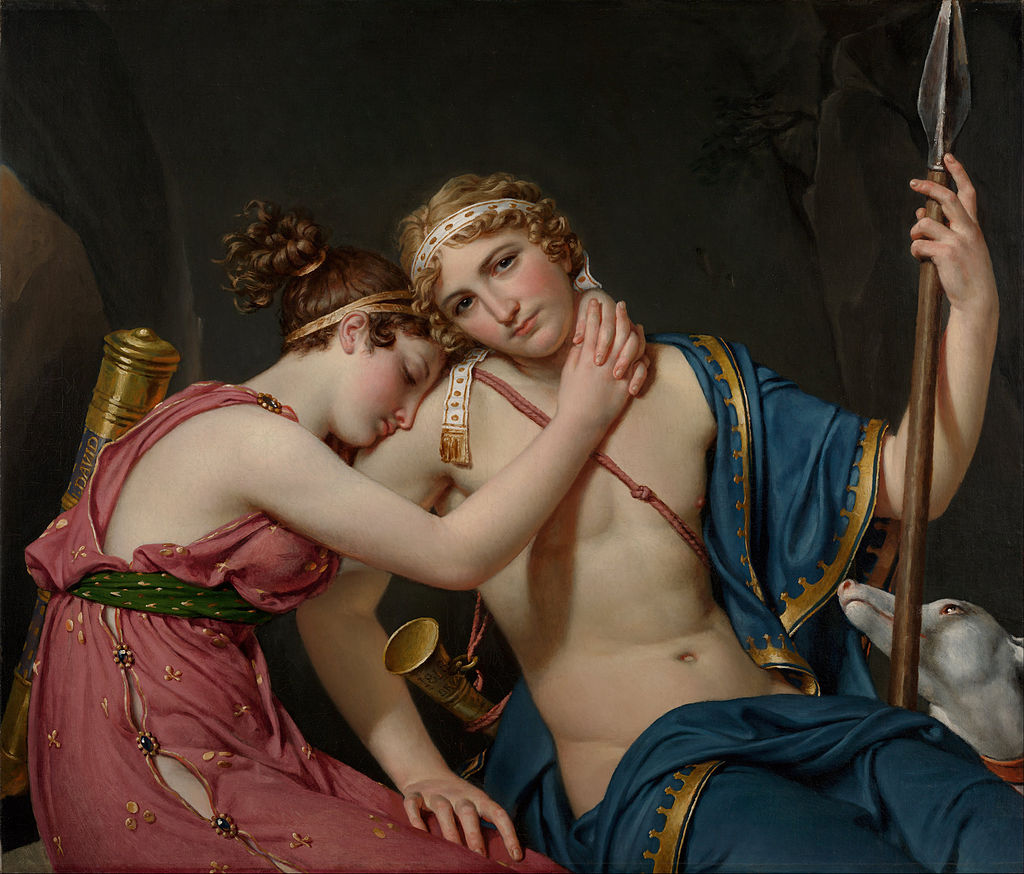
Where? Room S204 of the J. Paul Getty Museum
When? 1818 Commissioned by? Unknown. However, just before David finished the painting, it was bought by Franz Erwein, Count of Schonborn-Wiesentheid, a politician and art collector from Germany. What do you see? The beautiful nymph Eucharis is on the left. On the right is the muscular Telemachus, the son of Odysseus and Penelope. Telemachus and Eucharis are in love with each other and say their final farewell in a dark cave before Telemachus will leave to continue the search for his father. Eucharis has her head on his shoulder and her eyes closed while embracing Telemachus. She wears a red dress (called a chiton), which is held together on the side and the top by jeweled clasps. She also wears a green sash which accentuates the shape of her breasts. On her back is a golden quiver, inscribed with the last name of Jacques-Louis David. Telemachus has golden, curly hair with a decorated hairband is bear-chested, and wears a blue garment with golden edges. He has his right hand on her thigh, and he holds his spear with his left hand. Telemachus already seems to be thinking about the future and looks at the viewers of this painting. On his back, he wears his golden horn, which is inscribed with the year and the place at which the painting is created (1818, Brux.). On the right is the white hunting dog of Telemachus. He looks at Telemachus to support him at this moment. Backstory: According to Jacques-Louis David, he created this work to complement his painting Cupid and Psyche from 1817 in the Cleveland Museum of Art. He created Cupid and Psyche for an Italian art collector, count Sommariva, but there is no evidence that the painting on Eucharis and Telemachus was also intended for him. In 1818, Franz Erwein visited the studio of David just before he finished the painting of Eucharis and Telemachus and bought it. The Getty Museum acquired this painting on an auction in 1987 for a little bit over $4 million. The last time the painting was sold before that, in 1950, was for only $3,950 to a private dealer. 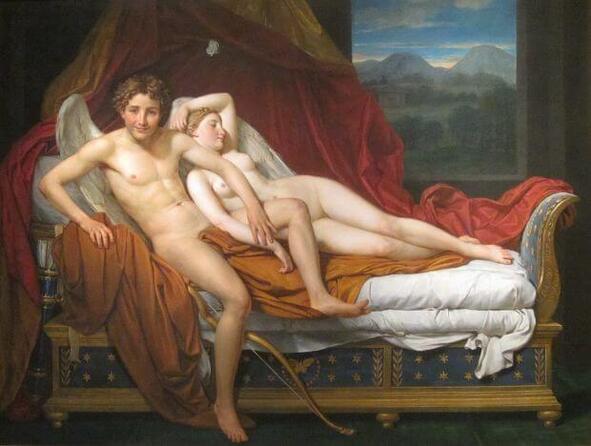
Cupid and Psyche by David
The story of Eucharis and Telemachus? Telemachus is the son of the Greek hero Odysseus and his wife, Penelope. He is well-known because, in the first four books of the Odyssey (Amazon link to this book) by Homer, he searches for his father. Odysseus had left for Troy when Telemachus was still a baby and was already gone from home for 20 years.
The story in this painting by Jacques-Louis David is inspired by the popular French book Les Aventures de Télémaque, fils d’Ulysse, translated as The Adventures of Telemachus, Son of Odysseus (Amazon link to this book). François Fénelon wrote this book in 1699, and it fills in some of the gaps in Homer’s Odyssey, specifically the extensive travels of Telemachus to find his father. While they are on the isle of the goddess Calypso, Cupid makes Eucharis and Telemachus fall madly in love. However, at some point, Telemachus needs to leave to continue the search for his father, Odysseus, and they arrange a final moment to say goodbye to each other. Interestingly, though, this specific moment of goodbye is not described in the book by Fénelon. Who is David? Jacques-Louis David was born in Paris in 1748 and died in Brussels in 1826. He is a Neoclassical painter and had a large number of students, including Jean Auguste Dominique Ingres. He mainly painted portraits, historical scenes, and mythological scenes. An example of the latter is The Death of Socrates in the Metropolitan Museum of Art. David was a supporter of the French Revolution, and in 1804 he was appointed the court painter of Napoleon. There, he painted the famous The Coronation of Napoleon which is in the Louvre. When Napoleon was defeated in 1815, David moved to Brussels even though the new King, Louis XVIII, offered him a position as court painter. In Brussels, he continued to paint until his death.
Fun fact: David was politically engaged in his life and his paintings often contained moral and social messages. However, after he moved to Brussels, he lost his political influence in France and his painting style changed. He wanted to focus more on the composition of his paintings and enjoy the last years of his life peacefully, without painting deeper political messages.
The Farewell of Telemachus and Eucharis painting seems to have two relatively straightforward symbolic messages.
|

- Home
- Blog
-
Museums
- Alte Pinakothek
- Art Institute of Chicago
- Baltimore Museum of Art
- Barber Institute of Fine Arts
- Bargello
- Barnes Foundation
- British Museum
- Church of Sant’Anastasia
- Cleveland Museum of Art
- Courtauld Institute of Art
- Detroit Institute of Arts
- Frans Hals Museum
- Galleria Borghese
- Gallerie dell'Accademia
- Getty Museum
- Guggenheim
- Hermitage Museum
- Kunsthistorisches Museum
- Kunstmuseum Basel
- Legion of Honor Museum
- Louvre
- Mauritshuis
- Metropolitan Museum of Art
- Musee d’Orsay
- Museum of Fine Arts in Boston
- Museum of Modern Art
- National Gallery in London
- National Gallery of Art
- National Museum in Poznań
- Norton Simon Museum
- Ny Carlsberg Glyptotek
- Palace of Versailles
- Palazzo Pitti
- Palazzo Vecchio
- Petit Palais
- Philadelphia Museum of Art
- Prado
- Pushkin Museum
- Ravenna Art Museum
- Rijksmuseum
- San Diego Museum of Art
- Santa Maria delle Grazie
- St. Peter's Basilica
- Städel Museum
- Statens Museum for Kunst
- Tate Britain
- Tate Modern
- Timken Museum of Art
- Uffizi
- Vatican Museums
- Wallace Collection
-
Artists
- Altdorfer
- Anguissola
- Berlin Painter
- Bosch
- Botticelli
- Boucher
- Bronzino
- Bruegel the Elder
- Brunelleschi
- Cabanel
- Caillebotte
- Canova
- Caravaggio
- Carpeaux
- Cezanne
- Cimabue
- David
- Degas
- Delacroix
- De Maria
- Donatello
- El Greco
- Fontana
- Fra Angelico
- Fragonard
- Gauguin
- Gentileschi
- Gericault
- Gonzalez-Torres
- Goya
- Hals
- Hogarth
- Hokusai
- Ingres
- Leonardo da Vinci
- Lippi, Filippo
- Longhi, Barbara
- Lorrain
- Makovsky
- Manet
- Massys
- Matisse
- Merian
- Michelangelo
- Mochi
- Modigliani
- Monet
- Panini
- Parmigianino
- Perugino
- Picasso
- Pisanello
- Raphael
- Rembrandt
- Renoir
- Reynolds
- Rivera
- Rodin
- Rubens
- Scultori
- Seurat
- Steen
- Tintoretto
- Titian
- Toulouse-Lautrec
- Turner
- Uccello
- Van der Weyden
- Van Dyck
- Van Eyck
- Van Gogh
- Van Hemessen
- Vasari
- Velazquez
- Vermeer
- Veronese
- Vigée Le Brun
-
Locations
- Books
- About Us