Where? Room W204 of the J. Paul Getty Museum
When? 1870 What do you see? Two well-dressed people are depicted in a green landscape, probably a forest or park near Paris. On the left is a somewhat shy woman in a long white dress (no, the white dress is not stained like an art critic from that time said, but it is the trademark Impressionist painting style). he man on the right wears a somewhat informal, but neat set of clothes and a brown hat with a red ribbon around it. He holds the hand of the woman to guide her through the dense, uncultivated terrain. With his left arm, he pushes the bushes aside such that they can continue on the small path they are walking. The woman slightly lifts her white dress and has her head turned over her right shoulder as if she is hesitant to continue down the path. There seems to be some love connection between the two. The couple is enjoying a relaxed stroll through the landscape, and the painting technique of Renoir makes them blend into the landscape. Renoir used the light in this painting to emphasize the presence of the woman and the path through the forest. The man is standing in the shadow and only parts of his pants, hands, collar, and hat capture some sunlight. Backstory: In 1989, the Getty Museum paid $17.7 million to acquire this painting. The title of the painting is La Promenade, which means ‘the walk’. However, it is not certain whether Renoir gave this title to the painting or whether it was given later on by auctioneers. This painting is a direct result of his interactions with Claude Monet, who had advised him in 1869 to use lighter colors. Monet himself also used lighter colors, and you can see some of the similarities between this painting by Renoir and Woman with a Parasol - Madame Monet and Her Son by Monet in 1875, which is in the National Gallery of Art. 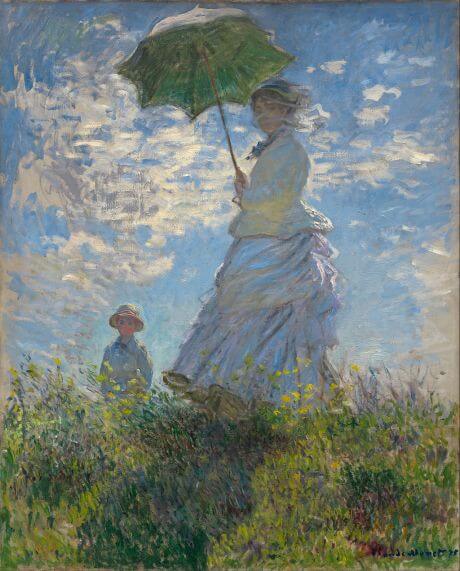
Woman with a Parasol - Madame Monet and Her Son
The birth of Impressionism: In the 1860s, in France, the government and the powerful art institutions were in control of the type of art that was exhibited. The artists paid a lot of attention to the details and finish of their works. Under the lead of Édouard Manet, a group of artists changed their style to what we now call Impressionism. Manet hosted a twice-weekly meeting with painters such as Cézanne, Degas, Monet, Pissarro, Renoir, and Sisley.
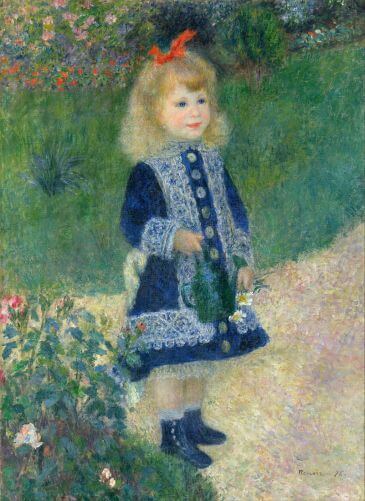
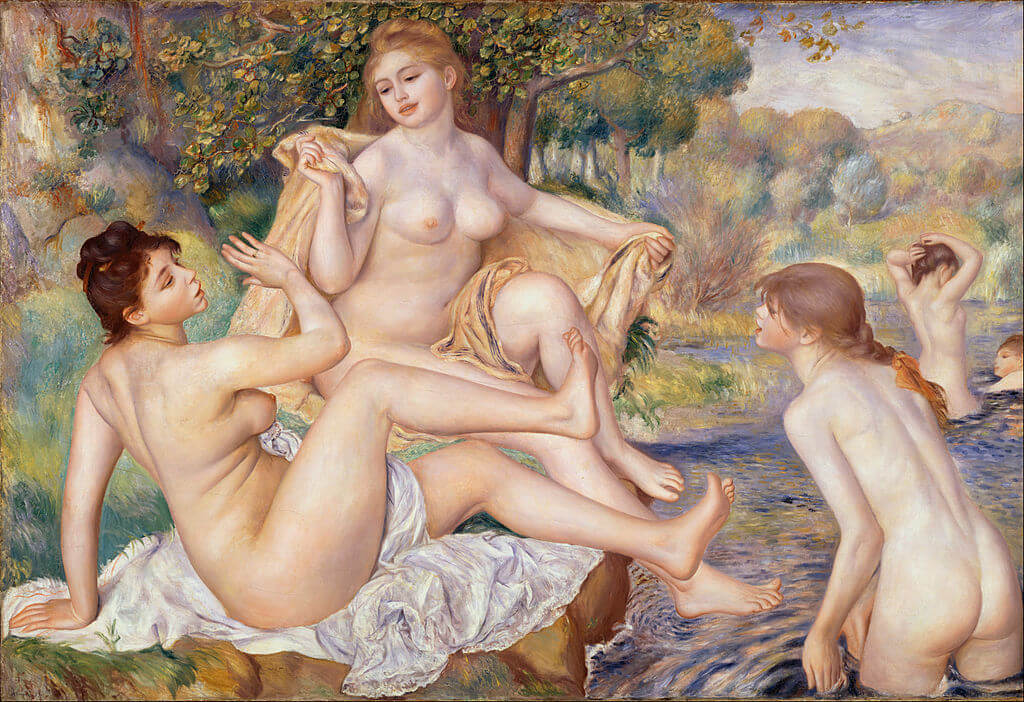
Among other things, the Impressionists wanted to capture quick, transitory moments in time. To do that, they changed the technique of painting. Before, different layers of paint were applied on top of each other, with long waiting times in between each layer to make sure each layer dried properly. Impressionists, however, wanted to paint their observations in a single session and had to immediately apply the right color of paint to the canvas as they could not resort to the underlying layers to create the perfect color. Who is Renoir? Pierre-Auguste Renoir (1841-1919) was a French impressionist artist. He is often referred to simply as Auguste Renoir and he also signed this painting with A. Renoir. He was a talented singer and wanted to become a professional singer when he was young. However, as singing was a risky career, he switched to painting in which he was also talented. His early work was inspired by Manet and Pissarro, and by his friend and contemporary, Claude Monet. By 1879, Renoir was considered to be a successful painter, and he took some time to travel around Europe and North Africa to become familiar with the works of Delacroix, Raphael, Titian, and Velázquez. Some of his famous works include A Girl with a Watering Can in the National Gallery of Art and The Large Bathers in the Philadelphia Museum of Art.
Fun fact: The man is this painting is probably Alfred Sisley, a British impressionist painter who lived most of his life in France. Sisley was a friend of Renoir. They met in art school in Paris in 1862.
The model for the woman in this painting is probably Lise Tréhot. She had a relationship with Renoir and served as a female model for almost all his paintings between 1866 and 1872. While not a lot is known about the exact nature of their relationship, they may have gotten two children together. The first may have died as an infant. In 1868 Lise gave birth to a girl, Jeanne, who was given away to a nurse. Indirect evidence that this was the child of Renoir as well is that he secretly provided financial support to Jeanne during his life, even though he has never publicly acknowledged her as his child. Interested in a copy for yourself? Poster
0 Comments

Where? Ravenna Art Museum
When? 1570 or 1573 Medium: oil on copper, 16.5 x 13 cm. What do you see? The monk looks out with eyes that draw our attention. He appears stern and sober, and his short beard may indicate that he is relatively new to the order. He wears a blue waistband and holds a piece of paper in his right hand. The paper's content is largely illegible, but just below his thumb, we can identify some text reading "157.". It refers to the year this work was painted, but the last digit is hard to read. The books at the end of the table and on the shelf behind him are indicative of his education and knowledge, which would have been deeply respected. 
 Original version of Self Portrait in a Straw Hat (1782)
Where? Room 33 of the National Gallery in London
When? 1782 Medium and size: Oil on canvas, 97.8 × 70.5 cm. What do you see? A self-portrait of the 27-year old Élisabeth Vigée Le Brun. She painted herself standing outside, wearing a straw hat with an ostrich feather and a garland of wildflowers. And she holds a palette and seven brushes in her left hand. She portrayed herself as an independent and emancipated woman, traits that helped her to become a successful artist in a male-dominated art world. Many other young ladies would have worn a corset, a wig, and a lot of make-up. Instead, Vigée Le Brun portrays herself in a fashionable, pink cotton dress, a black shawl, a straw hat, a pair of earrings, and her own hair. Vigée Le Brun paid particularly careful attention to the impact of two light sources, the sunlight and the daylight. The impact of the sunlight is apparent when looking at how she painted her eyes in the shadow of the straw hat. The result is that the viewer is naturally directed to look at her neck and chest. Backstory: The painting in the National Gallery is actually a copy of a version she made earlier in 1782 and exhibited at the Paris Salon. The original painting is in a Swiss private collection and only a low-resolution image of it is available. The self-portrait of Élisabeth Vigée Le Brun was inspired by the Portrait of Susanna Lunden (c. 1622-1625) by Peter Paul Rubens, which is also part of the collection of the National Gallery. In 1782, during her travels with her husband, she came across Rubens’ portrait in Antwerp. She was particularly impressed by the way Rubens simultaneously incorporated the effects of both natural daylight and sunlight. She immediately started to apply these ideas to her own portrait. After she returned to Paris, she created a second version of this painting, which is the one in the National Gallery today. The same year she also painted the Portrait of Yolande-Martine-Gabrielle de Polastron, Duchess of Polignac, which has a quite similar composition. 
Where? Room 27 of the National Gallery in London
When? c. 1513 Medium and size: Oil on panel, 62.4 × 45.5 cm. What do you see? It shows a portrait of a grotesque woman in luxurious clothes. Her face is somewhat malformed due to her suffering from Paget’s Disease. Matsys did not try to idealize her, which is also evident by the wart on her cheek. The woman, however, is dressed in luxurious clothes, including a beautiful brooch on top of her headgear and several rings on her hands. Her outfit would have been fashionable some decades earlier, but by the time this was painted, it would be out of fashion. The painting is a pendant to the portrait of An Old Man, which Matsys painted in the same year. The woman is depicted as a temptress, which Matsys expressed via various clues. First, she holds a rosebud in her right hand, a flower with sexual connotations. Second, she shows a fair amount of cleavage, which would be considered quite scandalous. Third, her headgear decorated with roses, also known as a escoffion, is in the form of a heart shape, although it may simultaneously be interpreted as a pair of horns.
Four Stages in Cézanne's Career: This post is part of a series of four providing an overview of the development and change in Paul Cézanne’s approach to his landscapes from the 1860s to the early 1900s. Each part is concerned with a time period of approximately 10–12 years. Scholars have recognized each section and have named them for convenience of recognition.
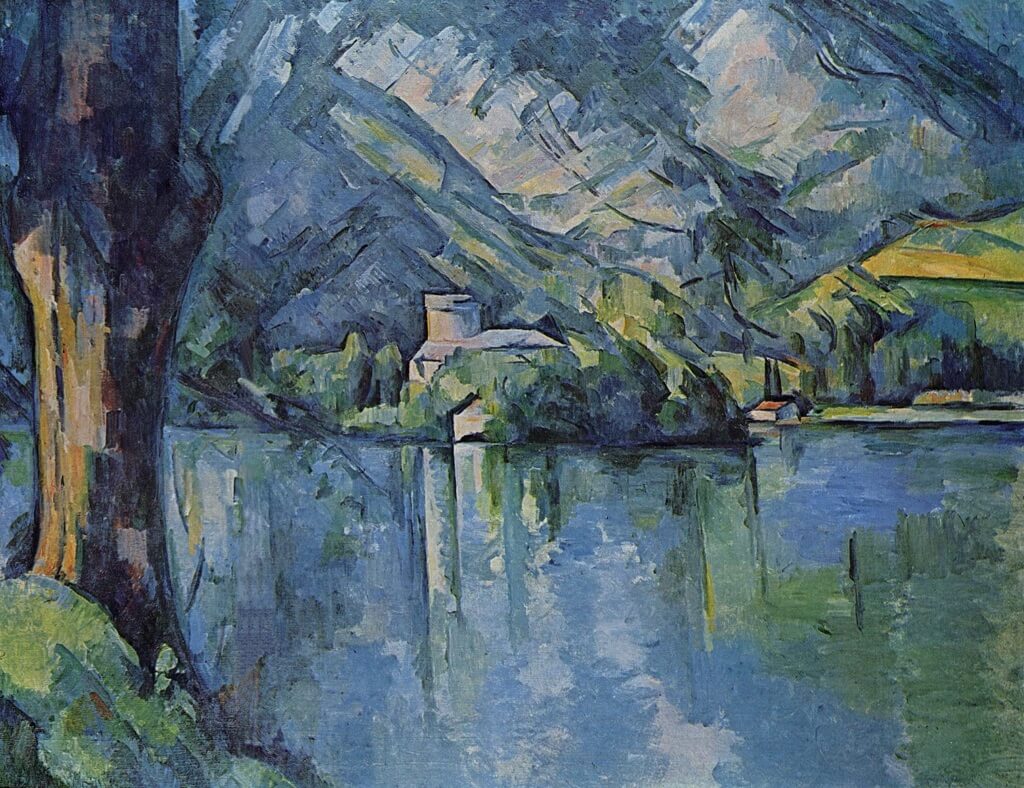
The Lac d'Annecy (1896) by Paul Cézanne
Where? The Courtauld Institute of Art in London
When? 1896 Medium and Size: Oil on canvas, 64.0 x 81.3 cm. What do you see? A view of Lake Annecy and the Chateau de Duingt, situated in the French Alps, not far from the town of Annecy. The medieval fortress has been there since the 11th century. The view is from the opposite shore over the lake toward the castle. A large tree provides a frame on the left. The tree trunk disappears at the top edge, and the branches and boughs of the tree overhang the upper edge of the painting, their diagonal brushstrokes complimenting the background mountains and framing the view. The castle is situated at the center, with the lake in front and the mountains stretching into the distance behind the partially hidden buildings. Diagonal brushstrokes going in opposing directions create height and depth in the mountains. Highlights of rust, ochre, blues, and greens take the viewer deeper into the hills and valleys. The emerald/blue water is calming, with elongated reflections created with the edge of a palette knife. The light source comes from the left of the artwork and focuses attention on the reflections, tree trunk, and buildings. The contrast of the dark on the opposite side of the highlighting accentuates the importance of the objects in the painting. It is a peaceful scene, yet the composition and the colorings are somewhat startling at first glance. However, it is also a stirring work that asks the viewer to look harder.
Four Stages in Cézanne's Career: This post is part of a series of four providing an overview of the development and change in Paul Cézanne’s approach to his landscapes from the 1860s to the early 1900s. Each part is concerned with a time period of approximately 10–12 years. Scholars have recognized each section and have named them for convenience of recognition.
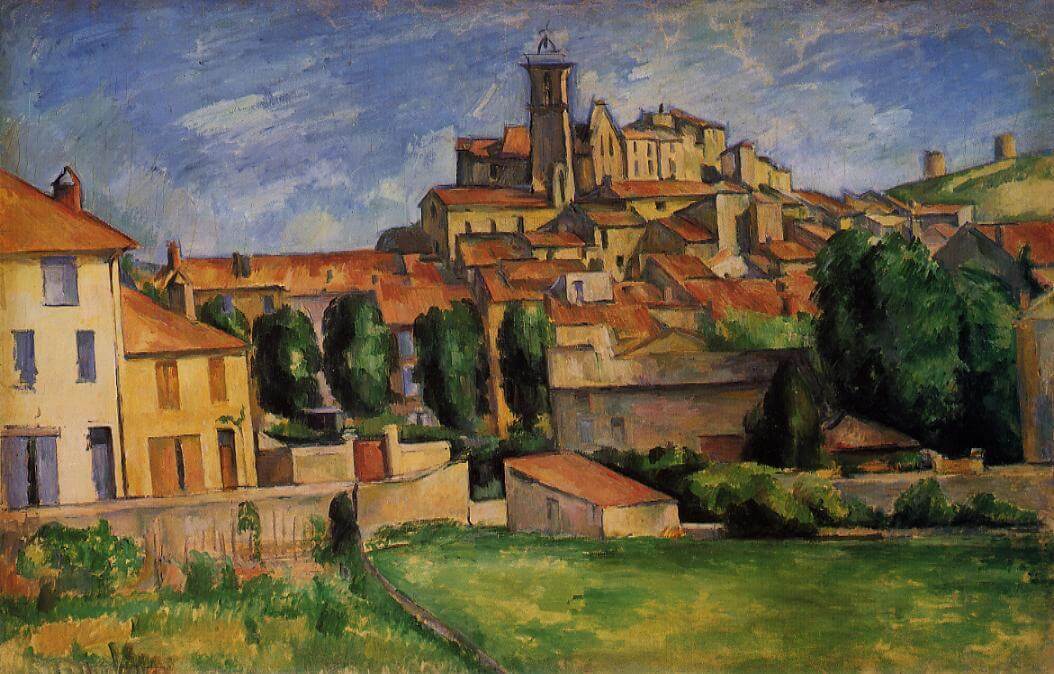
Gardanne (c. 1885) by Paul Cézanne
Where? Barnes Foundation, Room 2, West Wall.
When? c. 1885 Medium and size? Oil on canvas, 65.0 x 100.3 cm. What do you see? A horizontal view of the city of Gardanne in Southern France. The panoramic view is controlled by the use of blue/gray tones to collect and join each building block of the painting. There are squares and rectangles that build the scene, creating the illusion of distance and leading the eye upward to the highest point where the important bell tower has been positioned in the center of the work. The trees and greenery form their own shapes that give more cohesiveness to the buildings. The outline strokes and the shadows delineate the red roofs and gently lead the eye up the hill. On the right-hand side, just above the top of the hill, are two towers that may be from factories beyond. There is an architectural feel to the painting, but the warmth of the colors dispels any coldness. The scene appears to lean slightly toward the left, which may add further interest to the whole.
Four Stages in Cézanne's Career: This post is part of a series of four providing an overview of the development and change in Paul Cézanne’s approach to his landscapes from the 1860s to the early 1900s. Each part is concerned with a time period of approximately 10–12 years. Scholars have recognized each section and have named them for convenience of recognition.
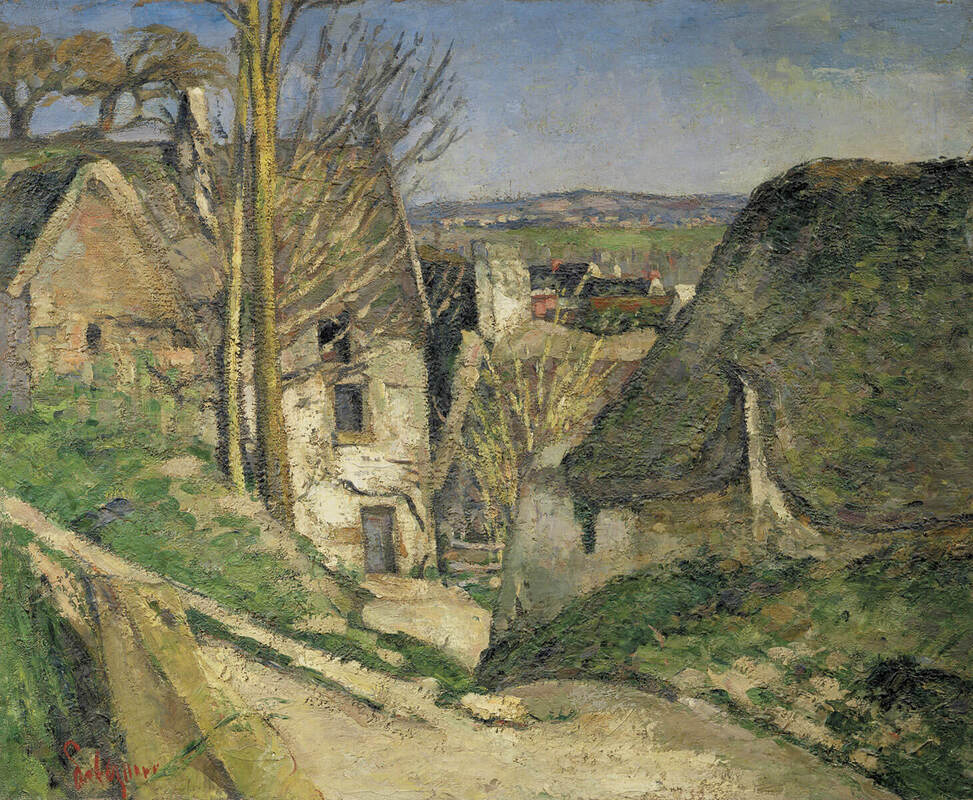
The Hanged Man's House, Auvers-sur-Oise (1873) by Paul Cézanne
Where? Musée d'Orsay
When? 1873 Medium and Size? Oil on canvas, 55 x 66 cm. What do you see? This painting is from the years Cézanne spent with the artists who would become known as the Impressionists. In the foreground, a right fork in the road leads steeply down a half-hidden pathway toward a large house with an attached outbuilding. On the right side of the painting is a bank that blends into a thatch roof attached to another building that could be part of the larger house or another house itself. The left fork in the road leads up the hill towards a group of trees in full leaf that bend to the right. The large house in the middle is partially hidden by tall, straight, leafless poplar trees. The construction of the center provides depth and distancing as the rooftops of the village houses lead further into the scene. Beyond the roofs and chimney tops, the green gardens or fields lead to more houses and the hilltop in the right center. The blue sky sets the tone for the whole painting. It feels monochromatic, but the painting is actually full of color. The white on the side of the house, the chimney in the distance, and the rooftops invite the eye further and deeper into the scene. On close examination, the blue of the sky can be seen throughout the painting and is reflected tonally in the rocks, the thatch, the village buildings, and the doorways and windows, as the blue blends, complimenting and connecting each section of the artwork.
Four Stages in Cézanne's Career: This post is part of a series of four providing an overview of the development and change in Paul Cézanne’s approach to his landscapes from the 1860s to the early 1900s. Each part is concerned with a time period of approximately 10–12 years. Scholars have recognized each section and have named them for convenience of recognition.
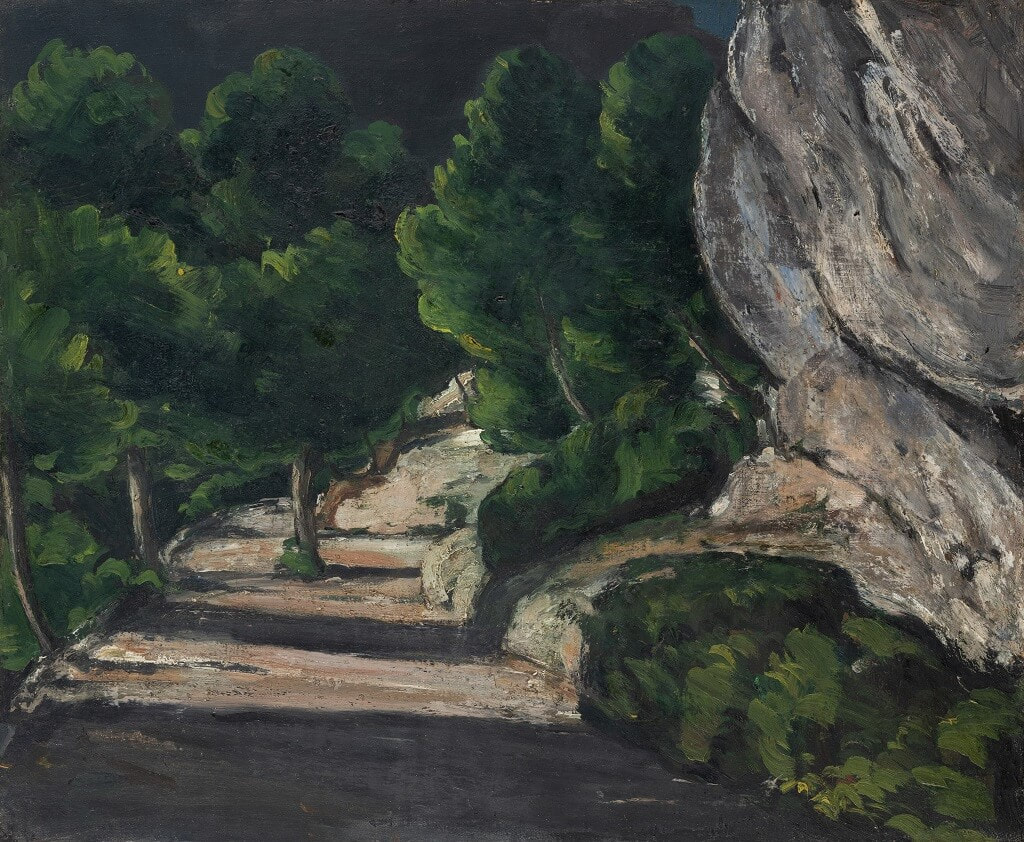
Landscape, Road with Trees in Rocky Mountains (1870–1871) by Paul Cézanne
Where? Städel Museum in Frankfurt
When? 1870–1871 Medium and size: Oil on canvas, 65.0 cm by 53.7 cm. What do you see? This is one of Cézanne’s early landscapes from his late “couillarde” period. He crudely described his own style at the time as ‘ballsy.’ Between 1862 and 1872, he painted in very dark colors, the paint applied thickly with a palette knife or thick impasto brush strokes. The strokes are visible and create texture that has a visceral feel to it. By zooming in on the painting, the navy-blue to almost black background is visible. It helps to create the sinister, unseen, section of the road. Light sources come from the yellow brush strokes slashed on the tips of the tree branches and white paint was applied on the road and rocks on top of the undercoating of darker navy/gray. The layering and alternating light/dark colors produce the perception of depth. Waves of brush strokes create the rocks on the right. The strokes appear to have been painted quickly, dragging and dropping bits of color as the brush flew across the canvas, almost in rage or frenzy. The brush strokes and the composition of the trees and rocks draw the eye upwards to the darkness. It is a powerful piece of art that pulls the viewer in, an invitation to experience either the lightness of the sunrise/sunset or to feel the impending darkness and with it a sense of foreboding. The rocks and trees loom over the road, a dare to walk or ride along it. The story choice is the viewer’s but with Cézanne’s paintings, there is always a demand for a reaction. 
Where? Kunstmuseum Basel
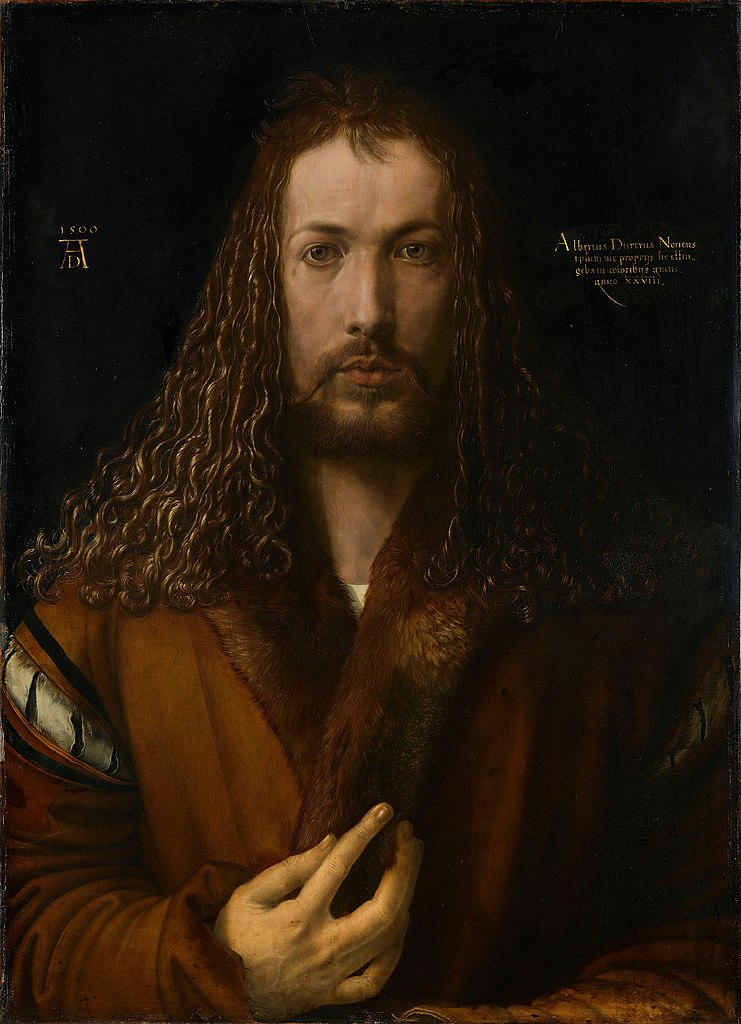
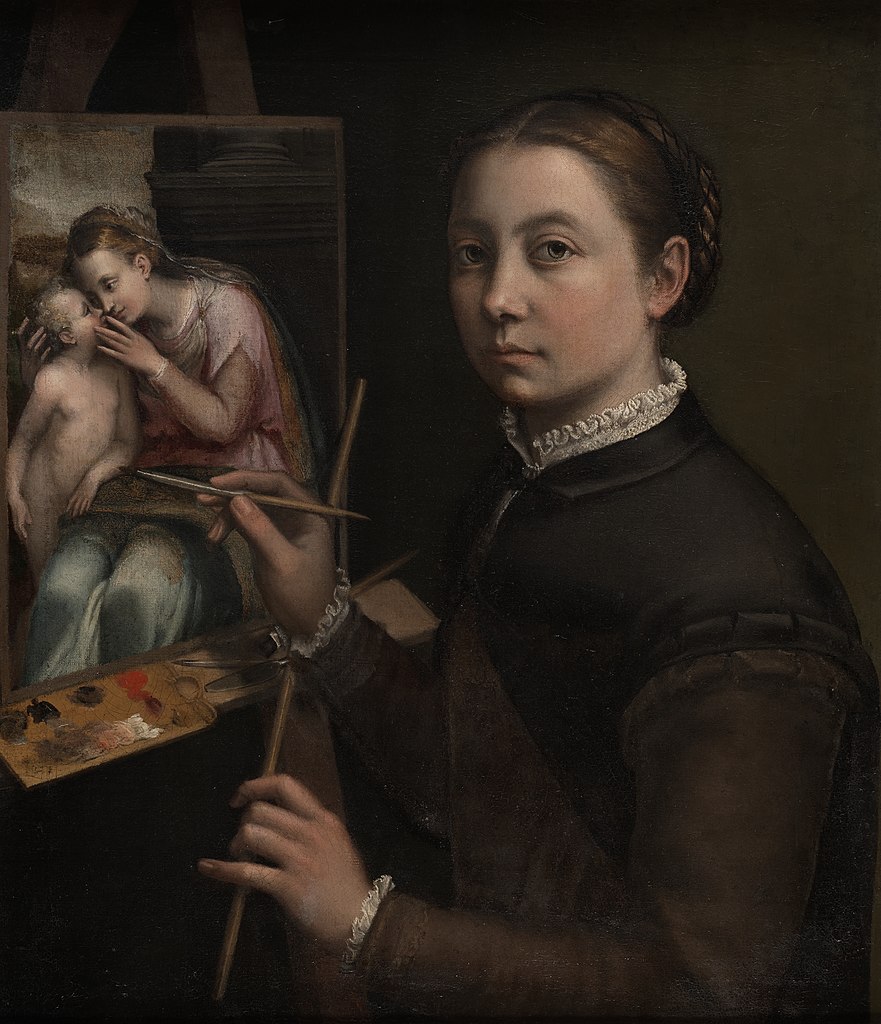
When? 1548 What do you see? A self portrait of the 20-years old Caterina (also spelled Catharina) van Hemessen. It shows the artist at her easel, working on the outline of a face. She probably looks into a mirror, not at the viewer. She wears the traditional wired head cover (haube) made of fine linen or perhaps delicate cotton that confirms she is at work or may refer to her devoutness. She holds her brushes and palette with the ease and familiarity of an artist. The brushed velvet of her clothing is expensive and proclaims her status and wealth in society. The white of the oak panel on the easel draws attention to the beginning of her drawing. The portrait of herself seems to be a bit out of proportion, with her head and arms appearing relatively larger than what her body suggests. Note also the cross created by her brush in her right hand and the maulstick (rest or steadying stick used when painting) in her left. Perhaps she is equating her painting ability to a gift from God that she is sharing. Van Hemessen has reversed the drawing on the panel from what the viewer sees in the finished portrait to provide a triangle from the unseen mirror, to the brush, to her face. She signed her finished painting: "Ego Caterina de Hemessen me pinxi 1548; Etatis suae 20" which translates to; I, Caterina of the Hemessens, painted me in 1548 at the age of 20. She wanted to be remembered. Backstory: It is one of the oldest self-portraits painted by a woman, but more importantly, she has painted herself seated at the easel. Albrecht Dürer (1471–1528), who died the year Caterina van Hemessen was probably born, painted several portraits of himself and is recognized as an early exponent of the self-portrait genre. Dürer never represented any of the paintbrushes, palette, easel, or even an allusion to his craft. Caterina not only makes it clear that she is a painter, she conveys that she is educated, wealthy, and suggests her religious nature. Caterina's contribution to and development of self-portraiture can be seen in the following years as several of her fellow female artists also eternalized themselves at the easel, including Sofonisba Anguissola (1532–1625), Artemisia Gentileschi (1593–c.1653), Michaelina Wautier (1604–1689), and Judith Leyster (1609–1660).
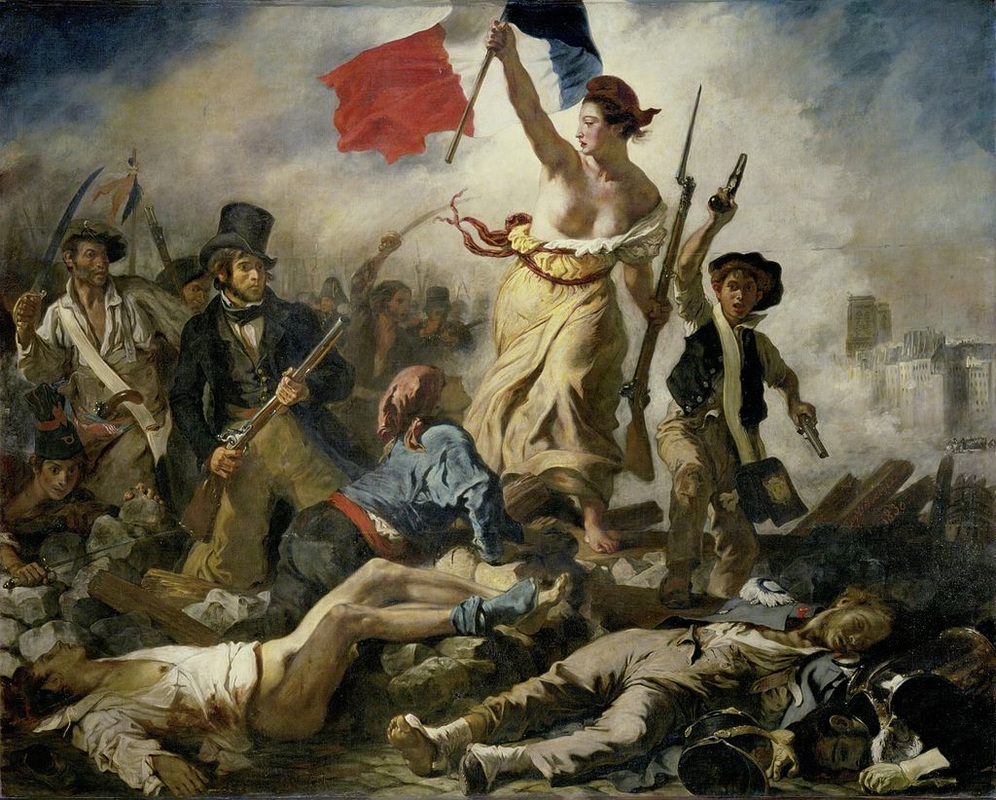
Where? First floor, room 700 of the Denon wing in the Louvre
When? 1830 What do you see? This painting represents what a revolution feels like for the people involved. The woman in the center, referred to as Liberty, is holding the French tricolor. She stands on top of a barricade, which you can recognize by the pieces of wood and the cobblestones in the foreground. Liberty represents the struggle of the common people for freedom, but at the same time, she shows the energy and excitement that was part of a revolution. In her left hand, she holds an infantry musket. This is a rifle with a bayonet fixed to it, in case she needed to spear an enemy from close range. Liberty is depicted in a victorious pose, and she is showing her breasts to the people. Liberty is surrounded by a mix of people from the French society. On her right is a child brandishing a pair of guns. At her feet is a day laborer from the countryside wearing a blue jacket (notice the red, white, and blue pattern in his clothes, resembling the French flag). The man to Liberty’s left, with the black jacket and the top hat, is represents the middle-class people (some say it is Delacroix himself, but there is serious doubt about this claim). The man in white on the left is a factory worker holding a saber. There is a sharp contrast between the victorious people fighting for the freedom of France and the dead people in the foreground. In the bottom right, you can see a dead soldier and a guardsman. In the background, you can see the smoke of the cannons. In the top right background, the city of Paris is visible with the two iconic towers of the Notre Dame. Finally, the two spars of wood on the right show the signature of the painter, reading “Eug. Delacroix 1830.” |

- Home
- Blog
-
Museums
- Alte Pinakothek
- Art Institute of Chicago
- Baltimore Museum of Art
- Barber Institute of Fine Arts
- Bargello
- Barnes Foundation
- British Museum
- Church of Sant’Anastasia
- Cleveland Museum of Art
- Courtauld Institute of Art
- Detroit Institute of Arts
- Frans Hals Museum
- Galleria Borghese
- Gallerie dell'Accademia
- Getty Museum
- Guggenheim
- Hermitage Museum
- Kunsthistorisches Museum
- Kunstmuseum Basel
- Legion of Honor Museum
- Louvre
- Mauritshuis
- Metropolitan Museum of Art
- Musee d’Orsay
- Museum of Fine Arts in Boston
- Museum of Modern Art
- National Gallery in London
- National Gallery of Art
- National Museum in Poznań
- Norton Simon Museum
- Ny Carlsberg Glyptotek
- Palace of Versailles
- Palazzo Pitti
- Palazzo Vecchio
- Petit Palais
- Philadelphia Museum of Art
- Prado
- Pushkin Museum
- Ravenna Art Museum
- Rijksmuseum
- San Diego Museum of Art
- Santa Maria delle Grazie
- St. Peter's Basilica
- Städel Museum
- Statens Museum for Kunst
- Tate Britain
- Tate Modern
- Timken Museum of Art
- Uffizi
- Vatican Museums
- Wallace Collection
-
Artists
- Altdorfer
- Anguissola
- Berlin Painter
- Bosch
- Botticelli
- Boucher
- Bronzino
- Bruegel the Elder, Pieter
- Brunelleschi
- Cabanel
- Caillebotte
- Canova
- Caravaggio
- Carpeaux
- Cezanne
- Cimabue
- Constable
- David
- Degas
- Delacroix
- De Maria
- Donatello
- El Greco
- Fontana
- Fra Angelico
- Fragonard
- Gauguin
- Gentileschi
- Gericault
- Gonzalez-Torres
- Goya
- Hals
- Hogarth
- Hokusai
- Ingres
- Leonardo da Vinci
- Lippi, Filippo
- Longhi, Barbara
- Lorrain
- Makovsky
- Manet
- Matisse
- Matsys
- Merian
- Michelangelo
- Mochi
- Modigliani
- Monet
- Panini
- Parmigianino
- Perugino
- Picasso
- Pisanello
- Raphael
- Rembrandt
- Renoir
- Reynolds
- Rivera
- Rodin
- Rubens
- Scultori
- Seurat
- Steen
- Tintoretto
- Titian
- Toulouse-Lautrec
- Turner
- Uccello
- Van der Weyden
- Van Dyck
- Van Eyck
- Van Gogh
- Van Hemessen
- Vasari
- Velazquez
- Vermeer
- Veronese
- Vigée Le Brun
-
Locations
- Books
- About Us